

Chinese Birth Chart vs Western Astrology: Key Differences Explained
How does BaZi differ from Western astrology? A side-by-side comparison of structure, elements, timing cycles, and why some people find Chinese birth charts more specific.
 AI Bazi fortune teller
People who are familiar with Western astrology often ask whether a Chinese birth chart is simply another version of a natal chart. The short answer is no — the two systems share some surface similarities but operate on fundamentally different logic.
Western astrology: a planetary system
Western astrology usually focuses on:
- Planets in signs (Sun in Aries, Moon in Cancer…)
- Houses (which life area each planet influences)
- Aspects (angular relationships between planets)
The result is a rich, multi-layered map of psychological tendencies and relational dynamics. It is a system that rewards deep study and offers nuanced emotional language.
BaZi: a time-cycle and element system
A Chinese birth chart (BaZi / 八字) focuses on a different set of variables:
- Four pillars built from birth year, month, day, and hour
- Heavenly stems and earthly branches — each carrying an elemental quality
- Five-element balance — Wood, Fire, Earth, Metal, Water in interaction
- Luck cycles (大运 and 流年) — how external energy shifts over decades
The chart is more compact (eight characters vs twelve planets + signs + houses), but the analysis can be equally deep.
Side-by-side comparison
| Dimension | Western Astrology | Chinese Birth Chart (BaZi) |
|---|---|---|
| Core inputs | Date + time + location | Date + time (no location) |
| Primary symbols | Planets, signs, houses | Stems, branches, elements |
| Number of key elements | 10 planets × 12 signs × 12 houses | 4 pillars × (10 stems + 12 branches) |
| Timing system | Transits, progressions | 大运 (10-year cycles) + 流年 (annual) |
| Personality anchor | Sun sign / Ascendant | Day Master (日主) |
| Element system | 4 elements (Fire, Earth, Air, Water) | 5 elements (Wood, Fire, Earth, Metal, Water) |
| Relationship analysis | Synastry (planet-to-planet aspects) | Chart-to-chart element interaction |
Why some people prefer BaZi
For people who want a symbolic system that feels personal yet structured, BaZi has a few natural advantages:
- It quickly establishes a core element. You get your Day Master within seconds, and it immediately anchors the entire reading.
- It highlights balance and imbalance directly. You can see which elements are strong, which are missing, and what that means for your daily life.
- It makes timing questions feel natural. "When is a good time to start something?" is a built-in question in BaZi, answered through luck cycles and annual flows.
Does one system replace the other?
No. Western astrology excels at psychological depth and relational nuance. BaZi excels at element-based clarity and timing structure. Many people find value in both — they answer different kinds of questions.
What matters is choosing a system that gives you actionable insight, not just entertainment. A Chinese birth chart reading should help you understand your energy patterns, identify timing opportunities, and make better-informed decisions.
Recommended reading
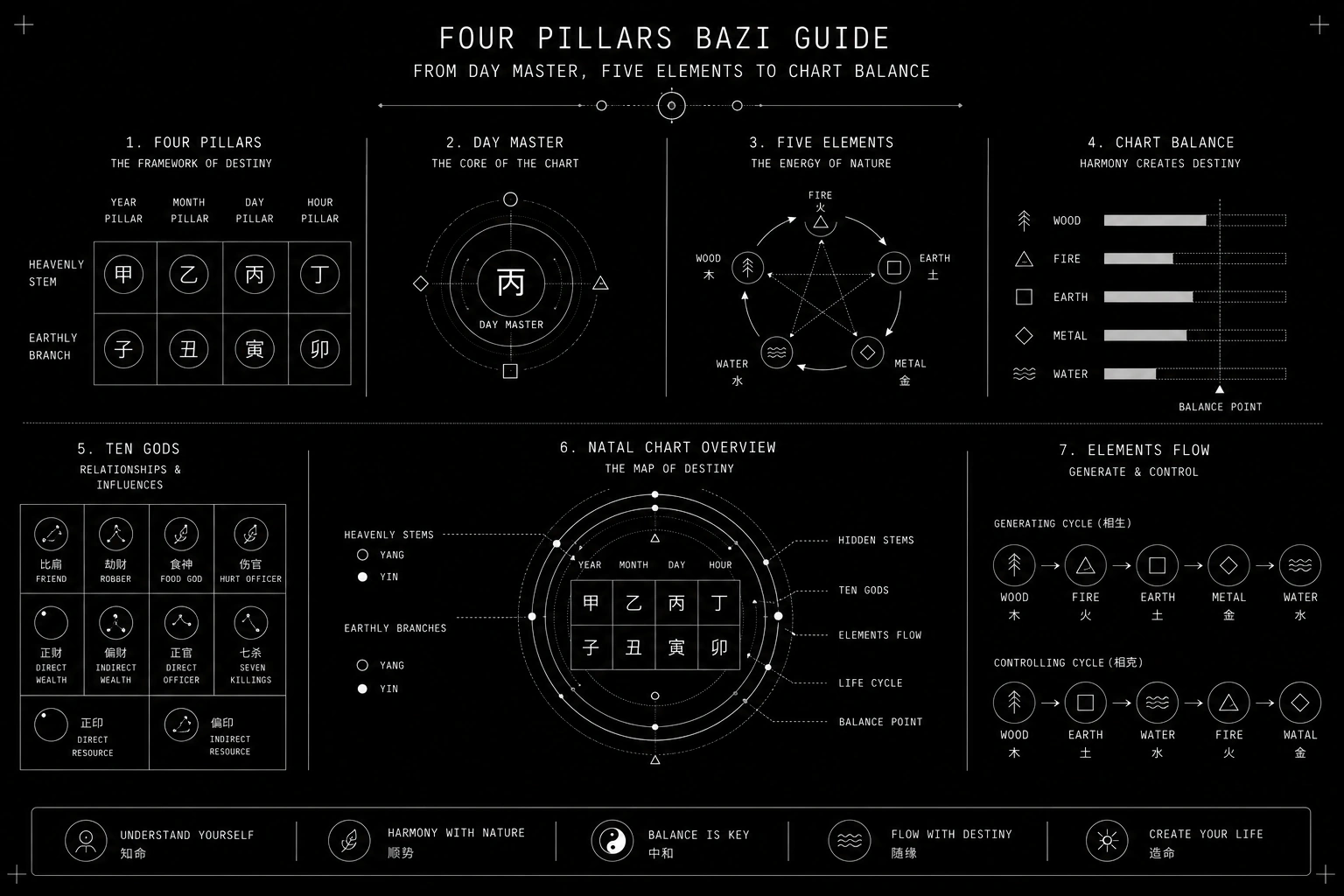
Four Pillars of Destiny Explained: A Practical Beginner Guide to BaZi
Learn how the Four Pillars of Destiny (BaZi) works — from Day Master and Five Elements to chart balance. A clear, modern introduction for beginners.
Jun 21, 2026AI Fortune Teller: What Makes a Reading Actually Feel Personal
Most AI fortune tellers produce generic text. Learn what separates a structured BaZi reading from random predictions, and how to spot the difference.
Jun 20, 2026