Guides, explainers, and product notes around BaZi, Chinese astrology, and MING.
Yi Wood day master personality explained: adaptive, artistic, socially sharp. See the common blind spots and how to turn yin wood traits into career strengths.
We compared the best AI fortune telling apps of 2026 — AskingMing, Co-Star, The Pattern, Nebula and more. Features, pricing, and who each app fits best.
What a five element imbalance in your bazi chart really means, how missing or excessive elements show up, and why balance is not the goal.
BaZi uses true solar time, not clock time. Learn why the difference can shift your hour pillar — and how to correct your birth time before reading your chart.
The Favorable Element (Xi Yong Shen) is the key to balancing your BaZi chart. Learn what it is, how it is found, and how to use it in daily life.
Learn what Day Master strength means in BaZi. Understand strong vs weak Day Masters and why balance matters more than raw power for your destiny.
Nayin (Na Yin) is an advanced layer of BaZi that maps each stem-branch pair to one of 30 elemental images. Learn what it reveals and whether beginners should focus on it.
Learn how the Ten Gods (十神) reveal career potential and wealth patterns in your Bazi chart. A beginner's guide to interpreting these key relationships.
Learn what the Day Master is in Bazi (Four Pillars of Destiny), how to find yours, and why it's the key to understanding your personality, career, and relationships in Chinese astrology.
The AskingMing team open-sourced the full Bazi toolchain powering our product: computation engine bazi-engine, bilingual terminology DB bazi-terms, and React chart component bazi-chart. MIT licensed.
What are yin yang and the Five Elements? Learn the core framework of Chinese metaphysics and how yin yang and the Five Elements shape every bazi chart.
What are Heavenly Stems and Earthly Branches? Learn how China's 60-cycle calendar builds your bazi chart — the four pillars of your birth moment.
BaZi reads five-element interactions while Zi Wei Dou Shu maps stars across twelve palaces. Compare the two major Chinese destiny systems — chart structure, analysis style, and which one fits your question.
The Ten Gods in BaZi reflect your core drivers in career and relationships. Learn how each Ten God type shapes your work style, relationship needs, and life priorities.
Not all AI fortune-telling tools are equal. Learn how to evaluate whether an AI BaZi reading is genuinely chart-based or just generic text dressed up in mystical language.
A side-by-side comparison of BaZi marriage compatibility, Western astrology synastry, and Chinese zodiac pairing — covering analytical depth, data requirements, and practical value.
The real value of BaZi is not predicting the future — it is providing a structured framework for self-awareness. Learn why "destiny" does not mean "fixed."
Understand the core logic behind BaZi marriage compatibility — Five Element complementarity, Day Pillar relationships, and Ten Gods pairing — and how AI tools make it accessible.
Understand the Five Elements logic behind daily fortune readings. Learn how your Day Master interacts with each day to shape your energy rhythm.
How does BaZi differ from Western astrology? A side-by-side comparison of structure, elements, timing cycles, and why some people find Chinese birth charts more specific.
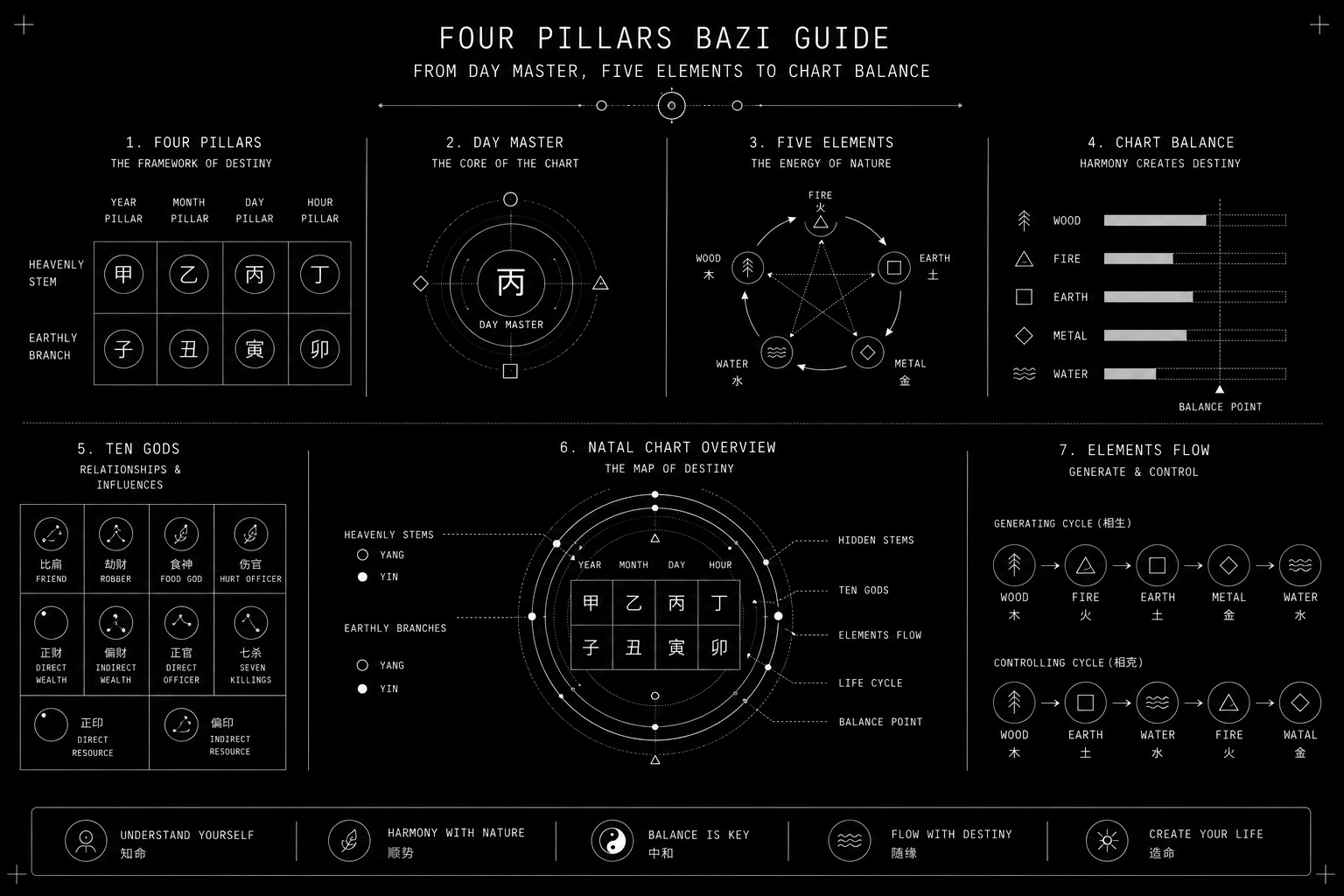
Learn how the Four Pillars of Destiny (BaZi) works — from Day Master and Five Elements to chart balance. A clear, modern introduction for beginners.
Most AI fortune tellers produce generic text. Learn what separates a structured BaZi reading from random predictions, and how to spot the difference.


 AI Bazi fortune teller