

BaZi Is Not Fatalism: Using Chinese Metaphysics for Self-Understanding
The real value of BaZi is not predicting the future — it is providing a structured framework for self-awareness. Learn why "destiny" does not mean "fixed."
 AI Bazi fortune teller
Many people react to "fortune telling" in one of two extremes: either they believe everything is predetermined, or they dismiss it entirely as pseudoscience. Both attitudes miss the most valuable part of BaZi.
BaZi is fundamentally a personality analysis framework
If you treat BaZi as "predicting what will happen to you," it becomes easy to question. But if you understand it as a personality and energy analysis framework based on birth-time data, its value becomes clear:
- It helps you understand what drives you at the core
- It identifies which areas feel natural and which require effort
- It shows how your energy focus shifts across different life stages
This is the same category of tool as MBTI or the Big Five — just with different dimensions and a different entry point.
Why "fated to happen" is a misreading
Traditional BaZi does use expressions that can sound fatalistic — "your chart lacks Fire" or "a clash year ahead." But what these actually mean is:
- "Missing Fire" → you may need to consciously develop expression, social energy, and outward warmth
- "Clash year" → that period brings more external change, requiring greater flexibility
- "Weak Day Master" → you thrive in collaborative settings rather than solo ventures
None of these are "fated." They are tendencies — just like MBTI saying you are an introvert doesn't mean you can't give a great talk. It just means public speaking costs you more energy.
Self-awareness vs passive acceptance
The right way to use BaZi is as a decision reference, not a fate sentence:
| Passive acceptance | Self-awareness |
|---|---|
| "My chart says I'm not cut out for business" | "My chart leans stable — entrepreneurship would need more external support" |
| "Bad luck this year, can't make moves" | "This year brings change, so I should plan more carefully" |
| "Our charts are incompatible" | "Our interaction patterns have friction points — worth understanding the differences" |
The left column creates anxiety or resignation. The right column creates direction. Same information, different framing, vastly different room for action.
MING's design philosophy
MING is designed around "self-awareness" rather than "fortune prediction":
- Reports avoid "fated to" language
- The focus is on "what your energy pattern looks like" and "how you can work with it"
- Suggestions are actionable, not immutable conclusions
That is the essential difference between MING and traditional fortune telling — not telling you "what your fate is," but helping you understand "how you can use your chart information."
Recommended reading
BaZi Marriage Compatibility: A Guide to Five Elements and Day Pillar Matching
Understand the core logic behind BaZi marriage compatibility — Five Element complementarity, Day Pillar relationships, and Ten Gods pairing — and how AI tools make it accessible.
Jul 2, 2026How to Read Your Daily Fortune: A Practical Guide Using Five Elements
Understand the Five Elements logic behind daily fortune readings. Learn how your Day Master interacts with each day to shape your energy rhythm.
Jul 1, 2026Chinese Birth Chart vs Western Astrology: Key Differences Explained
How does BaZi differ from Western astrology? A side-by-side comparison of structure, elements, timing cycles, and why some people find Chinese birth charts more specific.
Jun 22, 2026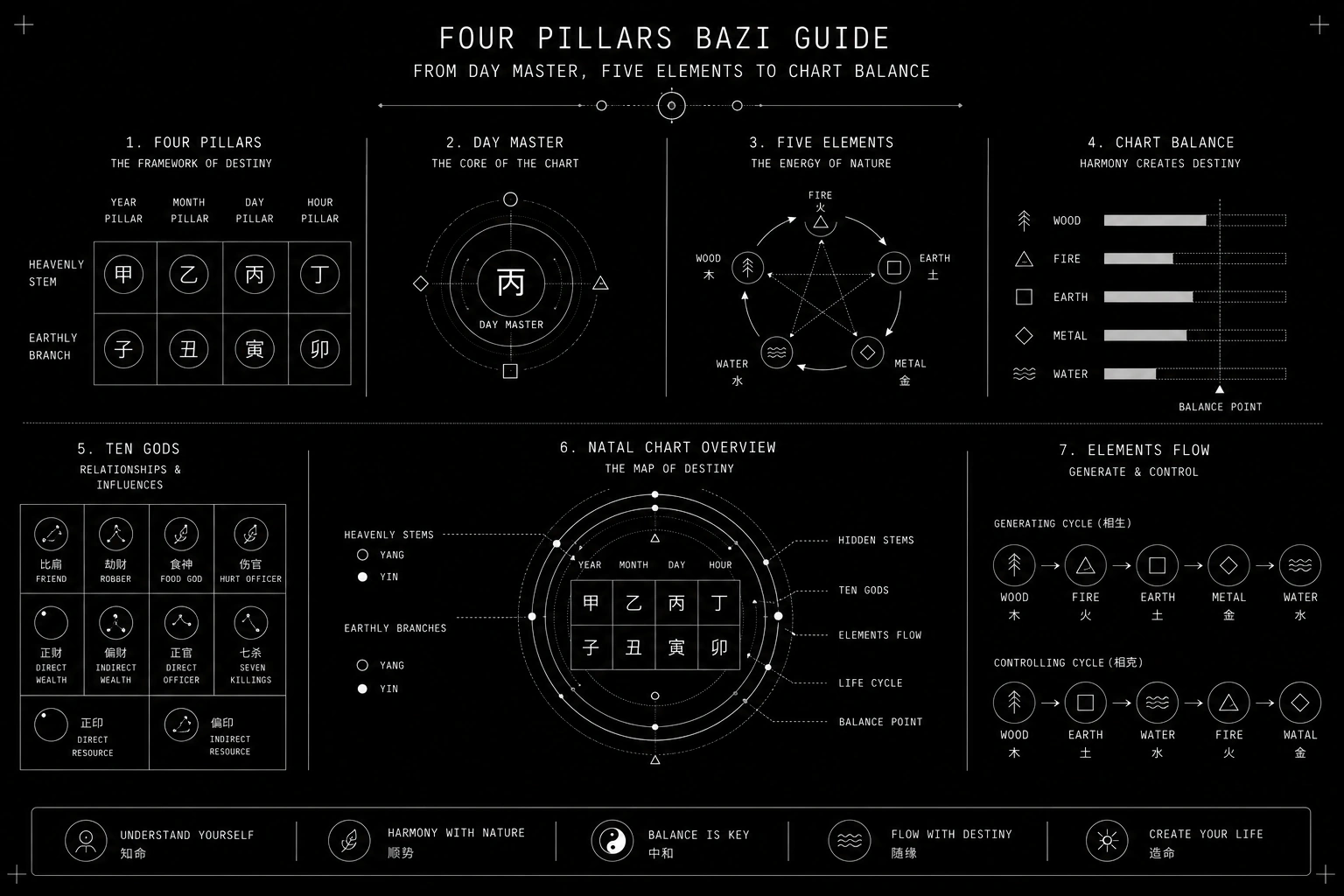
Four Pillars of Destiny Explained: A Practical Beginner Guide to BaZi
Learn how the Four Pillars of Destiny (BaZi) works — from Day Master and Five Elements to chart balance. A clear, modern introduction for beginners.
Jun 21, 2026AI Fortune Teller: What Makes a Reading Actually Feel Personal
Most AI fortune tellers produce generic text. Learn what separates a structured BaZi reading from random predictions, and how to spot the difference.
Jun 20, 2026